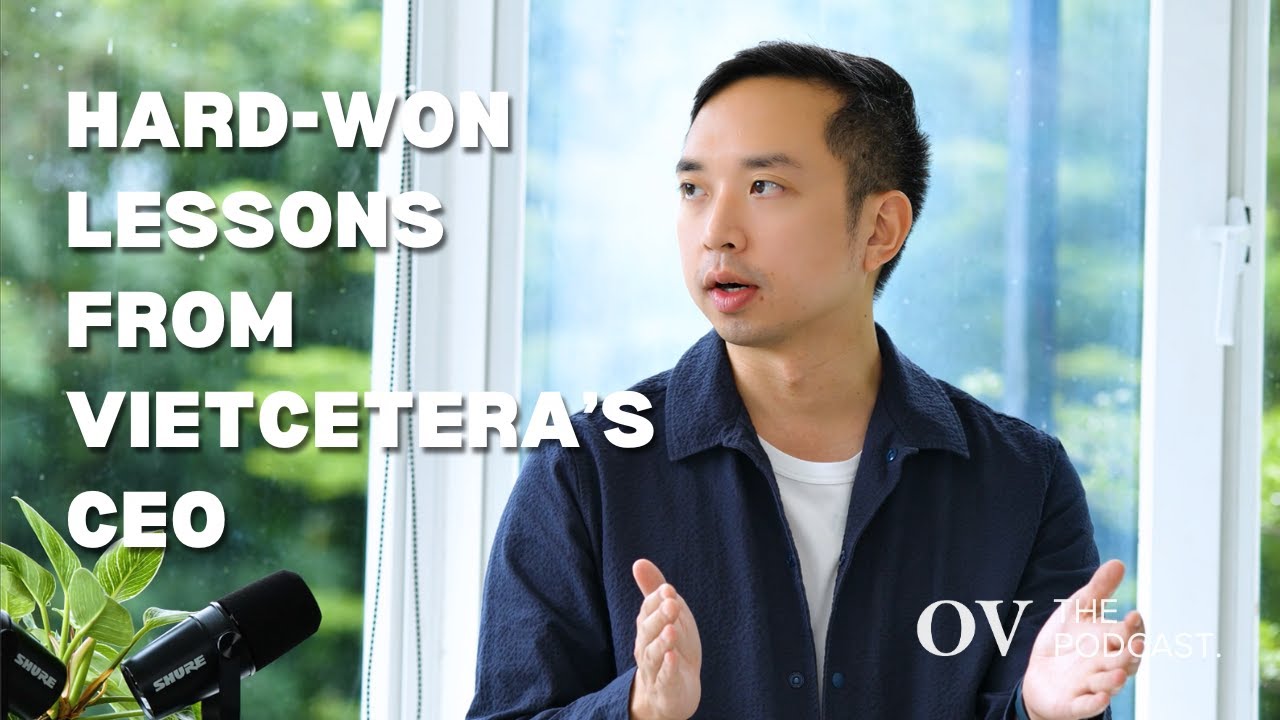
The conversation
Hao Tran grew up in the San Francisco Bay Area in a Vietnamese tech family, with parents from Huế. After Brown University he went into business development in Silicon Valley. In 2015 he was laid off, spent his severance on a trip through Asia, and ended it in a Saigon Airbnb whose host told him he should move. He took that seriously. In 2016, at 23, he joined 500 Startups in Vietnam on a salary of 6.6 million dong a month.
He started Vietcetera as a blog about the people he was meeting in Saigon, from fashion designers to restaurant owners. It began in English, with no business plan. Adding Vietnamese made it grow fast, and podcasts took it further. Today it has about 70 full-time staff, and he has been CEO since he was 24, leading a Vietnamese-language company without speaking Vietnamese natively.
In this conversation, Hao is direct about his mistakes: coming in too fast, building without the processes a growing team needs, and learning to slow down. He says Vietnam opens its arms but does not need overseas Vietnamese, so they have to show value. He gives practical advice for anyone thinking of moving: visit for two to four weeks between December and March, use the chambers of commerce, and message people with a clear ask.
He also shares how he sells to large companies, why business in Vietnam runs on relationships, what it was like to meet a listed Japanese company that wanted to buy Vietcetera, and three lessons for overseas Vietnamese: put the company in your own name, manage your currencies, and choose opportunities knowing what you are getting into.
Five takeaways
- 01
Show value first. Vietnam opens its arms, but nothing will be handed to you. Find your own space and show what you can add.
- 02
Visit before you move. Spend two to four weeks in Ho Chi Minh City, ideally between December and March, and know who you want to meet and why.
- 03
Ask clearly. His best hires messaged him and said what they wanted. Say why you want to meet, and never ask to pick someone's brain.
- 04
Send the work before the meeting. He sends a pre-read 24 hours ahead, then uses the meeting to build rapport. People listen when you come to solve their problem.
- 05
Build the foundations early. Moving fast without basics like an HR policy created confusion later. Speed early has a cost you pay as you grow.
Timestamps
Each one plays the video from that moment.
- 0:00Intro
- 1:12Who Hao Tran is
- 3:14Growing up in the Bay Area
- 4:48Laid off, then Saigon
- 6:46Why Vietnam
- 7:55What the layoff taught him
- 10:41How Vietnam changed in 10 years
- 14:22How Vietnam changed him
- 17:56What he got right and wrong
- 20:20What overseas Vietnamese should know
- 25:15Planning a move to Vietnam
- 27:23Vietnamese names abroad
- 31:06When to visit and where to start
- 34:40How to network and ask
- 38:29Why media
- 40:49The early years
- 42:21A story from Ted Osius
- 46:46Doubt and conviction
- 49:27Leading in a second language
- 51:25Selling to large companies
- 55:05His way of selling
- 57:54Doing business in Vietnam
- 1:00:21Leader, not manager
- 1:01:42The most validating moments
- 1:04:07Success means staying the course
- 1:05:34Staying focused and spending wisely
- 1:08:11Advice to his younger self
- 1:09:35The impact he wants
- 1:10:49What he wishes people asked
- 1:12:16Three lessons for overseas Vietnamese
- 1:13:40How to connect
Full transcript
ShowHide
Made automatically from the audio and lightly edited.
Hao Tran
0:00I remember when I went through immigration for the first time in Vietnam on the passport there's no diacritic. Technically no one would really know how to pronounce my name in Vietnamese. So the immigration guy is like how do you pronounce your name? The thing is I didn't know cuz my mom and dad always called me gong. So I actually had to ask my mom like how do you pronounce my name? Like could you spell it out for me? When we were growing up our parents would make lunch for us a bánh mì, a rice plate whatever and we take it to school and we throw it away. We were so ashamed of being Vietnamese, like stories like that. And I figured today I'm much more proud to be who I am. So that's part of the mission of Vietcetera to share that story to the world.
Quang Do
0:40Hao?
Hao Tran
0:41Yeah. Hey Quang, good morning.
Quang Do
0:42Good morning. Good to have you back on the show. Sure. We are talking a lot in private. I think a lot of overseas Vietnamese and members would love to hear more about you. Yeah. You're one of the few overseas Vietnamese that I know of our generation that actually came to Vietnam and successfully built, scaled, run a Vietnam business, meaning focused on Vietnam for the Vietnam market and with maybe a lack of Vietnamese proficiency even. But for those who don't know you, how would you introduce yourself?
Hao Tran
1:15Sure. Yeah, thanks Quang. I remember how we met back in like 2020. It must have been like March, April, May kind of thing during COVID. And it's in reflection amazing where we are today. You know, both of us and seeing how overseas Vietnamese has grown too. So yeah, big thanks and thanks for having me on the podcast. I think just as a little intro, so I'm the CEO co-founder of Vietcetera. So Vietcetera is a media company. Our mission is to bring Vietnam to the world and the world to Vietnam. And that's been the mission since day one. And the idea was that stories of Vietnam weren't told and weren't being told. For example, similar to your upbringing in Germany, probably mine in the US as well, you read all the headlines and whenever Vietnam did get into it, it was because of its bánh mì a Vietnam war anniversary or maybe something like trade related. But there's a lot of rich stories here. Especially when I arrived and I was very motivated to share those because as a Vietnamese as well overseas we all know like when we were growing up our parents would make lunch for us a bánh mì, a rice plate whatever and we take it to school and we throw it away.
2:33Yeah. We were so ashamed of being Vietnamese like stories like that. And I figured today I'm much more proud to be who I am. So that's part of the mission of Vietcetera to share that story to the world. So we do that in English. But our primary business is now Vietnamese language because it's also the other way around. There's a lot of Vietnamese who want to understand the world better, understand where they as an individual, where they their country stands in the world too. And we want to bring that content to them here as well. So yeah.
Quang Do
3:14Wonderful and would love to go into all the lessons you've learned of building Vietcetera and moving here and so I think there will be a lot of golden nuggets but quickly to frame bit of the context on you as well you walk us through your life a little bit.
Hao Tran
3:29Yeah. So Vietnamese American, born in San Francisco Bay Area. Parents are Vietnamese from Huế. They're both from like Huế proper. The both of them, but they met in the US. So, I think mom went to Pennsylvania first. Dad went to No, sorry. Dad went to Pennsylvania, mom went to Texas, and their dads knew each other from way back in the day. So, this is a very recurring theme, by the way. For whatever reason, there's a lot of Huế people that like moved to the states and they all kind of like knew each other after that. So anyways, for different reasons, they moved to California, Northern California, where there's a large Vietnamese population, and they met through their dads. And so I, you know, me and my brother, we were born and raised in the Bay Area. We're a tech family, so all of us are from Silicon Valley. Dad and brother work there, or used to. And then I was kind of also getting into that. I studied at Brown University in the east coast. Did my studies, came back to Silicon Valley. I worked at a couple tech companies like Palantir, Hotel Tonight. Kind of sharpened my skill set in that industry. And then I got the opportunity to move to Vietnam. So, the whole story goes like in 2015, I got laid off for my high-flying tech job.
4:56And I remember just like any other millennial at the time, you want to work. You have rent to pay. So, got a job right away, but I decided to take two months off first. So, I took my severance layoff pay and I blew it all on a trip to Asia. So, did my thing. And then the last stop was Ho Chi Minh. Saigon. So, I stayed in an Airbnb, rented a room in a house, and the guy that, rented the room, the host, this was when Airbnb was still cool, by the way, like when they were actual hosts, not just like companies. And he's this Australian guy who, entrepreneurial, I've been living in Vietnam, I think, five, 10 years at that point. And we just got along really well. He introduced me to some of his friends. He took me to his office and at the end of this four or five day stay, he told me like I should think about moving here. But he said it in a way that was like not serious. But I actually took that seriously. When I went back to the States, I'd spend my lunch breaks looking for opportunities in Vietnam. And but as many of us know, junior, you know, 20some fresh grad kind of pay is not the highest in Vietnam.
6:13And so I wasn't expecting too much, but then I read some articles online about this venture capital fund opening an office in Vietnam. So I reached out to one of the partners. There's some other podcasts on online too that tell the story a little bit more in depth, but basically I contacted him. His name is Binh Tran. And yeah, within a week we met and he basically offered me a job. So I moved out here for that. So that was 2016. So 10 years is now coming up in Vietnam.
Quang Do
6:46What was it initially that draw you to Vietnam or opened your mind up to that possibility of moving?
Hao Tran
6:54I think the big thing was like in San Francisco I felt a bit limited but I didn't know it at the time. Like everyone I met was like working at Google, Facebook or high-flying startup and you were either in sales or you're an engineer. And I remember when I graduated I had this like inferiority complex too cuz I worked in sales which means you're paid lower. At least initially I made a lot of money in sales but yeah it was lower, right? Like there's you're like a second-class citizen in San Francisco, right? Everyone's well paid but yeah you're non-technical. Yeah. Although I guess with AI now then it's going to change the game a little bit. But yeah, I just remember just I mean at the time I was really flourishing. I was I'm I know that I'm a type A person. I I'm on the ball. Like I get things done. When I got that layoff notice, it was a bit of a I guess a learning experience for me too because people run businesses at the end of the day. We're not families. We're not.
Quang Do
7:55Just quickly there what led to the layoff?
Hao Tran
7:57So I was there for almost two years and I was known as the very like you can all you can almost say like arrogant like okay young youngster right like I remember the cohort I was in we were all like BD people business development everyone was around mid20s late 20s but I was the youngest I remember I got the job and started when I was 21 I was super fresh everyone was like two at least two three years of like McKinsey Goldman whatever And I was I was arrogant. Yeah. I knew I was high-flying hot shot cuz like I came in I got the job. I was the youngest and I was really good at what he did. Like part of our job was like hedging. So I worked at Hotel Tonight. Yeah. And hedging like a hedge fund. You buy something and you know you bet on massive return later. We had this program where it was called pre buying where we basically buy rooms in advance and then resell it like a travel agent. You know, it's no different. It's essentially the same thing. And I did really well with that. I was like I loved like calculating all these spreadsheets, making tons of money. I was like I was like I should have worked in private equity or something. Why I got laid off was the company laid off 40% of the staff. And I knew when the notice was coming that I would be it because me and my manager, we didn't get along.
9:18So it wasn't about performance, but it was about attitude. It was about mindset. And I knew that I had like kind of abused it a little too much. And so when the notice came out, it didn't surprise me. But ironically, I'm quite friendly with my manager still. I don't talk to her all the time, but every now and then, she was a first-time manager. I was a first-time like employee. So that's like the worst match in the world because you have two people figuring out like how to get their professional life together. But I remember seeing her a few years ago in San Francisco. We had a we had a nice breakfast and coffee. Yeah, it was good learning experience. I that definitely set my perspective in a in a more balanced way. Yeah. And still made a ton of mistakes after moving Vietnam though and still do still fixing things.
Quang Do
10:08Yeah. I will say to everyone who's listening I think you're really good at whatever you do and I've been you know in touch with you since five plus years now and I just see the way you operate you know you figure things out very well and I would go beyond and say for any foreign or overseas Vietnamese building a business in Vietnam seems to be just very tough and you could probably speak on that but let's go to that time when you moved here 2015 15 this was right so let's reflect on the past 10 years a little bit since you know the day you arrived how has how has Vietnam changed and how has Vietnam changed you are you still arrogant.
Hao Tran
10:51Yeah you can say that I'm very confident yeah because the thing is I know I'm still quite American and you know Americans are known to be like dynamic I'm being obviously super biased right now like we're fast-paced we're risk-takers It's true. But it's almost like that was part of my upbringing. Like we were taught to be like that in America. Like for instance, Bay Area even more probably and that too. And like for instance in America when you get an employment offer, employment contracts are at will. Meaning like the next day you could be gone and they don't have to pay you severance. They don't have to pay you anything. But in Europe and Vietnam you have labor contracts. If you try to let someone go, there's certain like regulations too, right? But that are good for employers. But mostly you have to pay severance or it's not very fun to let someone go. But in the US it's like at will like literally you can walk into the office and you're gone like that day and you can't do anything about it. And that was normal. Yeah. I didn't know anything else. So when I came to Vietnam I was like what is this? It's like but it's how it is. It's just the mindset and regulations of course of the society which is totally fine. But I think even little things like that conditioned me in a way.
12:08To have to adapt in Vietnam. And we built like a great team, too. Like, you know, some of the people that were attracted to that work style. I'm not saying it ended up working super well, but at least in the beginning, that's what attracted a lot of the talent that we got. But anyways to answer your question more clearly I think the last 10 years have seen Vietnam bring so many more capable young people that are ready to take it to the next level. Even foreigners coming in now 10 years ago it used to be almost like taboo to come Viet or otherwise. Now it's more normal like when you when an expat or a Việt Kiều says I'm going to Vietnam. It's like, oh, that's like trend. That's like a thing. Yeah. Yeah. So, it's becoming like a thing. That that's a big shift. And I think also just working in Vietnam too, you have this very interesting phase that we're entering where a lot of family companies especially, they're second generation are starting to take over. So, people around our age, 20s, 30s. And that's also changing the that dynamic of doing business here. Not for the better or for worse, but something to keep in mind because I think 30, 40, 50 years ago when private businesses were only beginning to emerge in Vietnam because most were state-owned.
13:35Yes. Actually, all of them were state-owned, I think. And not until the 80s or 90s did you start to have privatization and that's still happening today. So, you have this like slow but gradual evolution of private companies. Even the government's like gone on record saying like, "Hey, the next, you know, golden age of Vietnam or whatever they call it and the resolution, it's like meant to foster private business, you know, new priorities, infrastructure spending. It's going to be a fun time here." Yeah. So, how can you make the most out of that? How can you be part of it? I think part of it is just kind of being here or, you know, being a member of OV so you get some insights or whatever, read, etc. But yeah, it's going to be fun, I think. Hopefully.
Quang Do
14:22How has Vietnam changed you in.
Hao Tran
14:24Oh, it changed me. Has it? Yeah. No, it has. I've become less funny. I used to be really funny at work and I think I'm starting to get it again. So, when I was like working for another company, you know, you could just do your thing. I used to be like the clown at work. And then when I started the company, obviously you can't do that cuz Yeah. Or as much because you know you have a brand reputation, you got to lead the team. You can't just do stupid things. Not that they were stupid, but you know just tease people, right? But part of it's kind of coming back now. I'm kind of loosening it up again. But I do feel like I missed out on this whole like peer-to-peer learning in my 20s because I I've been CEO since I was 24. So, not that I was not even ready for that, but I think in a more serious way too, I've changed to be perhaps a little bit more realistic. Al also rationalizing things a bit more, a little bit more careful too cuz the speed that I was used to I I've had to slow down.
Quang Do
15:32Okay. Yeah. Were you more risk seeking reckless?
Hao Tran
15:36I still am. I think I always like to go for the home run. But yeah, I've especially in recent years, I've tempered that risk taking.
Quang Do
15:48Why do you think that is?
Hao Tran
15:50Cuz you learn how to work here. Here like everything from the paperwork to policies to it's a very diverse work culture. In the US, it's actually mostly all Americans, like pretty much, or at least people that were international studied in the US, but here it's people from all around the world. And you have to remember that, too, cuz I lived in my little bubbles in the US, but here you have super diverse people. So, you also have to evolve your mindset. Yeah. So, for instance, one of the first things I ask like super new people to Vietnam, either they're here for work or they live here, is like, "Okay, go to your favorite coffee shop. Okay, great. We're enjoying this coffee. What do you think the waiter or the barista is making per hour or for the month?" And, you know, they'll say all these different things. And when I share with them like what the market average is, they're shocked. Yeah. Because that cup of coffee we're having, they have to work a half a day to earn it in some cases. Yeah. Or at least at least an hour or two hours if not more. So that humbles you too because you know I've had my periods where I've made zero dollars in Vietnam building my company but you know I'm a little better off now.
17:06But that also humbles you because it also you know the world is so big and when I was living in the US in these like they call it like Ivory towers cuz I went to an Ivy League school and then lived in the city San Francisco. You're just around like super highly capable overly privileged slash you know capable people basically that have a lot of resources. But here you know there is a lot of those people too don't get me wrong but the everyday people we have to learn how to speak with them work with them grow with them because the world is much bigger than just the little city of San Francisco. So yeah.
Quang Do
17:56Do you think that you get right in your Vietnam journey and what you do differently?
Hao Tran
18:02So I think overall I don't necessarily regret anything. I think I've learned so much and I know the work that I've been able to build has been helpful to people. I think some of the mistakes that I've made were coming in a little bit too bullish, too like aggressive. I think I didn't survey enough. But I mean, who does at 23 when I moved here, right? And I think the first few years were very chaotic, but I enjoyed it as well. But I created a lot of collateral damage in the process. And at the time it did there was no like quoteunquote damage, but you start to feel it later because you know you lay the blocks and changes the whole game makes things happen. But if it's not a steady foundation, then things will start to change.
Quang Do
18:56Give an example.
Hao Tran
18:58It's just like any company. Let's say you start hiring people. You need to have an HR policy. Yeah. In the in the US people are like oh HR you know but it's actually super important if you don't have that policy or process then later when you start growing it's just another random thing right so there's no consistency you create confusion at the time it was a great idea because you can be nimble you can be fast but then later you create confusion misunderstandings no that's just one example for instance but somehow in the US we didn't I don't know we didn't think about that as I don't know. In America, we have this like I don't know what do you call it? Ask for forgiveness later and then just do it and then ask later. I don't know if that's a normal thing. I have no idea. But that was generally.
Quang Do
19:47Don't ask for permission. Ask for forgiveness.
Hao Tran
19:50Yeah, that's right. And I still generally go that way like personally but at work now because I have other stakeholders and partners and you know just people you got to be more sensitive to that. And also that's another thing like Asian cultures are more sensitive whereas Americans are very blunt. So you know that I've had to adjust as well. I think in good times nobody cares but then during bad times people start getting touchy and feely about these things and then.
Quang Do
20:20Yeah there's some theme of you know you came bullish high energy naive maybe in some regards and now maturing leveling up you know running a big or there's a bit of a theme there but what do you wish or you know would hope more OVs, overseas Vietnamese would understand before coming.
Hao Tran
20:43Yeah, that's a really great question, Quang. I think the best way to frame it is as an overseas Vietnamese is there's huge opportunity here and I think Vietnam opens its arms, but it doesn't really need us. So, what I mean by that is when we when we come here, we got to show that we can provide value. It's not going to get handed to us. And I think if we have that mindset, we come here, collaborate, find our own spaces to do things, you then can create value that no one ever saw before. So overseas Vietnamese is very pioneering. It's very new. Basically, I mean, people have done things like it, but not in its way. And then Vietcetera, the same. There's tons of content companies, but no one has really done kind of what we focused on. It's not like anyone needs us. We have to create that want, show that value. So I think just show up knowing like we can create value together. But I I've heard of many people complaining about mindsets and you know mindsets not matching and blah. And yeah, I agree. Sure. Fine. But you know that's your problem, not theirs. We're guests here anyways, right? Unless you have a passport for us, but I don't.
Quang Do
22:02So what I'm hearing is probably and I do agree with that to create value one of the main ways is to build something basically right in your unique way and I think the false assumption is you have some form of western expertise and you bring it here and it will be valuable for Vietnam the way you bring it and so I even tell people who want to work 9 to5 who want to work for someone even then you need to have some entrepreneurial thinking in and framing to this because Vietnam is just so unique. Yeah. Right. So yeah I just see many people come they struggle to find the ways they can provide value. They have very good intent and I see this within the OV community a lot. But that's basically the main bottleneck. People want to come.
Hao Tran
22:56And I think it depends on what age and responsibilities and obligations you have. So, I came when I was 23, no family, no responsibility, and I took a job that paid me 6.6 million a month. That's what 500 Startups paid me. Sorry, Eddie. 6.6 million a month. So, but I also had savings. So, I think my first two years, maybe three, were like ne negative 10 million a month. I was spending 15 million a month on rent, getting around, food, you know, that kind of thing. Now, of course, if you're older, you have opportunity cost. You got to consider that, too. But I think here, you just got to get here. Nobody's going to give you hand you anything. You'd have to be like a very skilled, super experienced like executive to get paid even close to what you would want. But a lot of companies would want to work with our OV community. Like last night I hang out hung out with two OVs who are one's US, one's Canadian and they're both C-levels at Pizza 4P's. So one guy, his name is Roy. He's Vietnamese Canadian from Toronto. He's now the chief people officer and the other is the CTO Steve. Yeah. And they were sharing with me how 4P's like the kind of leaders that they're looking for are not like Việt Kiều specifically but people that are you know multilingual preferably because it's a global organization now like they're opening a shop in the US for instance so they need to have a leadership team that can speak to those experiences like if you're only a Vietnamese that has never like worked or lived abroad it is going to be tough to open a pizza shop in New York. Let's be honest about that.
24:45Like that's pretty crazy actually. So you need a diverse team to be able to confront that opportunity. Are they the most well paid? I'm sure they're well paid, but it's not going to be anywhere close to what they were making in the US. Sorry, Steve Roy. I don't know what you're making, but I'm sure you're doing pretty well. But yeah, the point is they're also here because they want to be part of the momentum. They know they want to contribute. They can contribute. Yeah.
Quang Do
25:15So, I I'll give you a very common scenario for overseas Vietnamese. Say it's 2025 now. You are 30, early 30s in the US, want to come to Vietnam. You've been working for a few years, making stable money. There's some predictable career path that you could just go along further. But Vietnam is calling in your subconscious and you've been traveling and you kind of open your mind to this thought, hear more stories from Vietcetera of people moving here. How would you approach and strategize moving to Vietnam if you would be more determined to do so within the next years?
Hao Tran
25:59Yeah. I think firstly maybe okay so maybe you're an OV, maybe you follow Vietcetera. You're connected to a few people online. I would try to come out here first and spend like two to four weeks like just in Ho Chi Minh and try to get plugged in. Know who you want to meet, why you want to meet them. I think that would be my first thought just to see if you even like the idea of staying here long term because it's not for everybody. Another consideration is like the career like is the job going to fit? Is the pay going to be it? And the answer is no. It's never going to fit. So I think you just have to be ready for that. I don't think I've heard of any story where like they move someone moves from the US and like day one they're like wow this is okay this well day one might be like amazing right and then after like two months it's like wait a minute you know that's normal that's very normal so there's the honeymoon phase yeah don't feel like you're going to immediately like get in right so you have to be prepared for that and a little bit of that uncertainty I guess you can say but it's balanced out with you great community. You can access social life. People you can always be meeting. It's much more dynamic than your everyday in the US. And because everyone is Vietnamese, you just get along a little bit I don't want to say better, but at least easier.
27:23Like I remember for me, I have a Vietnamese name. You have a Vietnamese name. So whenever we introduce our names in the West, people are like, "What?" Like Joe. No, not Joe. Like people would say Hao like H-A-L which is like the most American name you could possibly have and I'm like I'm definitely not a Hal, like, you know, no, Hao I remember I'd go to like let's say you go to a bar after work happy hour with co-workers and you meet other another company doing a happy hour and you people would ask for their names and like what you know like it's just so awkward right but then here you say you're Hao and they're like oh yeah or you say oh you're okay no big deal it's just normal so you just skip out that little extra step in introdu introducing yourself and it's a compounding effect too. Yeah. Cuz imagine doing that like five times a day in the US, you'd go brain dead. Like you just feel so it's almost like subconsciously you do not even like your own name. But here it's just like oh yeah, Hao, okay cool and you know let's move on. So like and yeah it's actually a thing. M I remember when I went through immigration for the first time in Vietnam in Vietnam or maybe second time on the passport there's no diacritic so technically no one would really know how to pronounce my name in Vietnamese so the immigration guys is like how do you pronounce your name and the thing is I didn't know cuz my mom and dad always called me gong oh that's okay which is normal right they would never call you by the name very rare and if even if they did because our ears are not trained to really pay attention didn't really know.
28:57And so I actually had to ask my mom like, "How do you pronounce my name?" Like, "Could you spell it out for me?" And so she did. And then from then on, like in my email signature, even on my LinkedIn, I put the diacritic. For Westerners or non- Vietnamese speakers, I'll still use my Anglicized name, just Hao. But for Vietnamese, I try to deliberately use my Vietnamese name with the diacritic now because I know it actually is a difference for them in pronunciation.
Quang Do
29:29Yeah, we Vietnamese we have struggles with names in the west. That's so common. Yeah.
Hao Tran
29:35What was your name? Quang.
Quang Do
29:38I was Quang. So my story is my story is a bit different. So my full name is actually Quang Huy. Which means my name is actually Huy. So that's how I grew up. So we Vietnamese we have this the structure of names that we have two names right whereas in west you usually have one name and I wasn't aware that you would use the this latter part as your calling name right and so I at some point just decided to use the first part of my name as my main name and so I became Quang okay whereas my whole family calls me Huy oh okay right so my full name is actually okay you know I call myself Quang which my family finds very weird and you were at my wedding right It's, you know, my mom taught me, hey, don't use the room for your wedding. Oh, yeah. Yeah. Oh, wow. Yeah. Okay.
Hao Tran
30:24So, in Germany, was it just easier to say Quang?
Quang Do
30:28Yes. It's okay. Huy is also easy, but it's easy in a way that it sounds it's easy to make fun of, right? Huy. It doesn't have meaning really. It's kind of like and so it's easier to make fun of saying or like, you know, some weird sound. It's like what did you say?
Hao Tran
30:44But by Quang it's I mean it's like other like minority or ethnicity names right like I mean I can't think of one right now but the idea is Vietnam is pretty unique in that you know it's yeah it's very hard for non Vietnamese to pronounce Vietnamese names and so there's a lot of correction going on for probably many Vietnamese in the world right.
Quang Do
31:06Quickly back to that scenario moving here you know you said people should spend two four weeks here you know how would you tactically spent those weeks and then actually moving forward with moving here. Would you work for someone, find a job first? Would you actually think about business? Would you start a side hustle? Would you continue your job in the US kind of remote if you can? Like how would you approach it?
Hao Tran
31:31So, well, first start with the time of year. I would always recommend December, Jan, Feb, because it's always a party atmosphere. People are always going out. It's dry season. It's easy to get around. Most of Vietnam is a nice to travel during that time. Generally speaking, that's probably the best time and also it's when a lot of others from overseas are coming or even Vietnamese come home for the holidays if they're living overseas. So that's what I would recommend and also a lot of the foreigners they'll leave during Christmas but they'll be around like especially January. So Tet this year is mid-February. Christmas is Christmas. So basically the expat population will leave during Christmas most likely like a week. Some will leave longer, but let's just say a week and then they'll come back. All of January will be just like fun times, zero productivity, but fun times. And then going into February, T, you know, the week before, during, and right after is a bit slow, but then it starts picking up again. I don't know, two weeks after TET, a week or two. Those are good times to come too because people are getting back into things. They're not on holidays so everyone's kind of here. And also around Jan, Feb, March, March as well is a good month.
32:48People start thinking about hiring. They're the new year starting their headcounts fresh. They're going to start thinking about who to bring on to the team. I think that's a good tactical, you know, when during the year. Don't come during the summer. Summer is not really nice in Vietnam. Let's be honest. It's muggy, it's hot, it's rainy. People are on holiday constantly. If you have kids, you know, you're you're going to the beach or you're you know, spending time with family and stuff, so it's a little harder. Wouldn't recommend that. So there's that. And I think just try to get plugged in before you come. Like you know, digital communities are like OV are very helpful for that. So if you follow things, you should be able to figure things out yourself. Another actually quite useful is these chambers of commerce, believe it or not. Yeah. So some are much easier to get into, but they're meant it's purely business, right? Like a lot of these companies and the chambers themselves are hiring people. Like I know the French chamber for instance, the director there, his name is Adam. Super friendly guy and always loves meeting people. But they have a division within the chamber that specifically helps French companies do more business in Vietnam. So he hires consultants that can speak French and obviously if you're French speaking that helps a lot.
34:06So I know quite a number of people that are like French Vietnamese that have like come here and then started there. I think the salaries and pay are modest like not bad but it's modest compared to probably what you can make in France. But it's a great start because you get to meet all these French companies. You get to meet the French entrepreneurs who have built huge businesses in Vietnam, too. It's a great way to network. You know, if you're French, you like to speak French, so, you know, do your thing. There's other communities for like Germans and Americans, too, but that's specific one.
Quang Do
34:40Yeah. How would you network? Would this be to get a job in Vietnam first?
Hao Tran
34:44You know, just be clear about what you want to do. I mean, I'm thinking even like myself. A lot of our most successful hires have been people that literally just messaged me and say exactly what they want. So, like, very to the point. Yeah. There's this one lady, I told you off the record, but I'll just share it on screen now. Yes. She's 24. She was born and raised here, but then left for like whatever number of years, and then just came back cuz her parents live here. She's Korean, but she speaks Vietnamese perfectly. And her message on LinkedIn was like, "Hi, Hao, I follow you, etc." That's all she said. I'm looking for a job in marketing and sales and would like to contribute to you your company. Here's one of the JDs I saw. Like, I'd like to just, you know, go out there because I tell people when you applied to Vietcetera, yes, go through the job portal because it's organized. We can get all your info, but if you like really want to gun it, just message me, too. I think HR is going to hate me after this, but message me, too. And if you feel confident that there's a match based on what I share on content and things like that, there's like a very high probability of getting an interview because once I send it to HR, they're like, "Oh, the CEO is messaging me. Let me follow up on this." And we've hired amazing people through that.
36:04Like including this one intern candidate. It's only been a couple weeks. So what I like to do is ambush people at work. So like you know everyone's got their meetings and they do their project meetings and then there's one weekly sync that a team has. So my whole afternoon was available. So I just look at you know where the meeting rooms are, what people are doing. I'm like yeah I'm going to go in that meeting. So in the middle of the meeting I just ambush everybody. They're like oh like they start having to pay attention and then she was doing her presentation. I was like it's really good. I'm I love to see that, you know, they don't just have to be well presented when the CEO is there. It's also as a team they can figure things out. Yeah. So that was really cool. So yeah, just messaging people just I think you know, never say words like I want to pick your brain. I think in English that's not a very American English people don't like when they say that. Pro tip. But just be very clear about what kind of value you can exchange with someone like another kid. I call him a kid, not a kid. He's like early 20s. This was about a year ago. He messages me on LinkedIn as well, and he literally says like, "Hey, Hao, I literally have nothing to talk to you about, but I just really want to meet you. Can I buy you coffee?" And I was like, "Yeah, I'd like this guy."
37:21Cuz he's exactly clear about his intention. He like literally doesn't know what he wants from me, but he just wants to meet me. Is going to get me a coffee. I'm in. So, like I had a nice pleasant coffee with him. Yeah. So guys, just message Hao if you buy me a coffee, I'll likely accept. But yeah, it's also just be very clear about why and like, you know, don't try to beat around the bush. And yeah.
Quang Do
37:45We talk about this often inbox full of a lot of I guess requests that sometimes feel less intentional, right? And you also don't want to be impolite. Or you want to actually help people, right? But sometimes it makes it difficult for you because it lacks context.
Hao Tran
38:01Yeah. It's kind of like, oh, how can I help you? It's like going into a restaurant, right? Okay, let's say you're a customer at a restaurant and you're just like there waiting to order. And of course, the waiter will be like, how can I help you? And you're like, yeah, I mean, I don't know why I'm here. I mean, then the waiter is going to be like, okay, I can't help you, right? Like, you come to a place because you want to order something, you want to talk to somebody. And the more curated high context it is you're gonna get more out of it.
Quang Do
38:29Yes. So cool. Hao, let's talk about building Vietcetera, the lessons you've learned you know would love to you know get some of the insights you've you know you have on building business in Vietnam why media out of all businesses and what did you see in media in Vietcetera?
Hao Tran
38:46Yeah. So I'm an accidental entrepreneur. Because when I started it, I think maybe you're somewhat similar, but I did not imagine at all what it would become. And my motivation at the time was to basically just share about the people I was meeting. So when I was blogging, I would be meeting all these cool people because in San Francisco, you meet a lot of cool people, but they're all tech. Yeah. But here, you can meet a fashion designer. You can meet a restaurant owner, a factory owner, somebody that's just getting their career started in an AI company. There's always quite diverse backgrounds here. And I remember like the first fashion designer I had literally ever met in my entire life was here in Saigon and I interviewed them. I think that was a great way for me to just like learn more. So it just was a snowball effect and the company just kind of grew from there. The opportunity just came and again no business plan at all. I think my company had 0.001% chance of any sort of success and it did make it to some level. We're not a huge company but you know we've made value. And people just responded to it. Didn't do any fancy market research, nothing.
40:07It's just kind of like we just made good content and then people started responding to it and that's when kept going. And the big one was when we introduced Vietnamese language cuz for the first year it was English only and then when we did Vietnamese it just grew like a rocket ship. That comes with other responsibilities and obligations too cuz at that point it's like really mass. Yeah. You're literally reaching 100 million Vietnamese much more directly. Because at the time when we were in English, we reached a lot of Vietnamese, but of course only the ones that spoke or read very good English. But now when you're doing Vietnamese, too. Yeah. It's just so much bigger. So, you're playing a different game, a business at that point. Yeah.
Quang Do
40:49What were those early years like?
Hao Tran
40:52Just like super chaos, which I loved, and then like every day you wake up, you're like ready to go. I'm still kind of like that, but not as much because it was so new in the market. I think the response from people was so great and.
Quang Do
41:05And was it initially?
Hao Tran
41:06No, it was a blog mainly. Yeah, just a blog. An article blog. We did some videos but mostly articles and then about 2020 we started doing more podcasts which is what we're really known for today. And that's when the company took another kind of level up. I mean what we're doing is not actually super innovative. We just happen to execute really well in some ways. And then we also take care of the content a bit more. We're a bit more diligent about it. I know that's very broad statement, but what I mean by that is like we're building IP. Yeah. So our content should kind of build on each other. So the podcast that I host, which is only one of a few shows that we have, it's a brand. And so that brand, I think my show in English, we've done 365 episodes. And which means on average I think that's 1.2 1.3 a week. Yeah. Today it's weekly. And actually funny enough cuz you know everyone's like oh do we really need another podcast? No we don't. But the thing is it's not about do we need another podcast. It's just about consistency and the purpose of that show. So for instance the one the best episode I've ever recorded was actually just a couple days ago. Like ever. Okay, it'll come out in a couple weeks, from the time of recording.
42:29I don't know when this podcast is coming out, but if if it's out by then, it's with Ted Osius. He's the former US ambassador to Vietnam, 2014 to 17. He then worked at Google. He was a VP of, something at Google, government affairs for Asia Pacific. Then he went, he's now working at US-ASEAN Business Council as like the managing director. His current job is really cool. He like when people like Tim Cook come to Asia they call him. Oh wow. Like he leads delegations like Boeing, Microsoft, Apple like when they come here they go to him. So he's got a big job. So we have him on the show. We start talking about that. But one really cool story that he shared was he was one of the first US government people to work in Vietnam after 95. He said it was like I think 97 or 99 he came started working in Hanoi and then he took a bike ride 16-day bike ride from Ho Chi Minh City to Hanoi and in the middle of that trip he's in the middle of like wherever you can listen to the podcast I forgot what he said but he's in the middle of the country and he's going through the rice paddies and in the rice paddies all he sees are just like ponds everywhere you know like the water in the land but in ponds just everywhere.
43:51So he asks the lady like what's going on, you know, it's just everywhere. And the lady was like, "Yeah, those are war bombs, like bomb craters." Yeah. From the 70s and just nobody cleaned it up. He said it much more eloquently, but he just remember thinking like so shocked cuz like this lady probably her first interaction with an American for many years was him. And he's just like this, you know, young gun diplomat moved from wherever he was like DC or whatever to Vietnam and his job was so literally like focus on forgiveness between people. Yeah. And I don't I'll send this podcast to him when it comes out. But there were moments during the show that I thought he was going to cry. Yeah. Because he was very strong about this. He was like that experience taught me like forgiveness this lesson of forgi forgiveness and he took it with him throughout his whole career at as a diplomat and all the way to ambassador and even what he does now because even today a lot of Americans specifically which is what he focuses on they don't really still know Vietnam they know Vietnamese food and yes there's a lot of Vietnamese in the US now but they don't really know what like Vietnam is so you know his whole career has been molded by this like belief of forgiveness between people and that forgiveness will then lead to amazing things if people put their minds to it.
45:17So he was sharing some stories like how Google wanted to have a physical office in Vietnam. But that was his idea apparently. And then you know he managed to get a couple the senior folks to buy into that and now they're here. They literally have a physical office in Vietnam. So he was the one pushing that and then he was sharing how when he was ambassador one of the big achievements was signing the something trade agreement. It was like for Asia Pacific like if you're in Asia Pacific US there's like free trade. The US ended up withdrawing from that during the Trump administration but then they still had a version of it that still exists today for Asia Pacific. And he said he was really proud of that because it encouraged more trade between countries, just more open dialogue and that actually set the basis for America's comprehensive strategic partnership today with Vietnam. So when Biden visited in 2023, there was a big announcement in Hanoi. People were super excited. And yeah, that relationship continues today. I think it's like 30 years anniversary this year between US Vietnam relations. I think there's a lot to look forward to. So yeah, like all of that track record is like built on this forgiveness, right?
46:34Okay, I'm a bit ranting now, but.
Quang Do
46:36It sounds like an interesting episode.
Hao Tran
46:39Oh, super cool. So, I thought it was only going to be like 45 minutes and it ended up being like 2 hours or something. I was like, "Oh, yeah, we got to go." Man.
Quang Do
46:46Okay. Just quickly back on Vietcetera business, you know, blog, English, Vietnam, focus, podcast today, many other things in your portfolio. What was that journey like in terms of conviction? You know, had did you have points where you thought this is not working in terms of monetization where you felt this is hopeless or this is working, you know, walk us through that journey.
Hao Tran
47:12Many times even to this day. Okay. I think because the stakes are bigger today than ever before because there, you know, we got 70 full-time employees, we have a P&L to run, we have liabilities, we have receivables, you know, all these things. The stakes are bigger than ever. And so these big macro decisions on making a CEO are much more impactful now than a few years ago. But yeah, to answer your question, there were quite a few moments. So for instance, one kind of existential moment was when we decided to introduce Vietnamese because when we were in English only, we were playing in a in a space that was more niche and smaller, so things were easier to control. But then when you move into Vietnamese language, then it's about restructuring your team a little bit to have that skill set. Also getting to know how that monetization works cuz also it's a different business model. And even partners are different. So, we had to adapt to that. And I had never worked in media before or any other parallel industry, but also in Vietnam. Like when I mean parallel, I mean like events, PR, like we were doing media. So, PR and events are next to us. Never did any of that. So had to learn a lot on the go and even today I'm still learning. So that's why even at the company level now I'm shifting a lot of resources and leadership to be quote unquote more like in the industry because that'll allow us to create more value because right now we're still a little bit at our high level.
48:45Like we're very Vietnamese organization but at the same time I'm a Vietnamese American. So how much can you really shift the mindset when you also don't speak the language natively? So people think like, Hao, you know your Vietnamese must be perfect. I'm like no, not even close. Yeah, it's kind of funny. I'm just another human being, but I run a Vietnamese media company language and I can't even speak the language natively. So when people are like, "Oh yeah, did you listen to that podcast? Hao, you did so your team did so great." So I was like, "Yeah, no. I mean I listened to bits of it but not the whole thing." So it was kind of funny.
Quang Do
49:27How was the shift for you as an entrepreneur from English, you know, then language you're comfortable with, the way of doing business you're comfortable with to now all in doubling down Vietnam, running Vietnamese content, leading Vietnamese teams. How was that for you?
Hao Tran
49:43Very difficult and it still is. I I've learned to learn how to navigate now. I have the people next to me that allow me to be mobile and adapt quickly, but I also still do struggle with a lot of things because when you can't read it like natively. Yeah. Or you can't you aren't able to connect with your staff on a very native level, especially when it comes to more sensitive things, you can't plan as much. Your reaction, you're more reactive, not proactive. And if you if you want to be more proactive, the time investment is quite is quite large because you need to rely on other people. So that was a big blessing for me too. And I think Vietcetera will be where it is and will keep growing. But if I were to ever do a new business too or even have a new role or job or you know whatever within Vietcetera or outside of Vietcetera, I would choose something probably a bit more global and I would like to do more B2B because that's what I like. I like selling like $100,000 contracts to like big companies, right? That's my specialty. You can ask in Saigon. And then you know, I like doing that stuff. So, I want to stay in my lane. I I've kind of learned what I really enjoy and yeah, really leveraging my strengths as a person and as a like individual contributor too.
51:01Like I know that like I love selling because I whatever I sell, you know, we're going to deliver assuming I have control of the product. And then yeah, just seeing those relationships like transform into something meaningful. We have a lot of those stories of the company. I'm very proud of them. So.
Quang Do
51:25How do you do B2B enterprise sales as a English speaker?
Hao Tran
51:30So okay, that's a great question. So people think that so Vietnam is very easy to live here if you're a foreigner. It's you won't have any problems linguistically. Now in work, Vietnam is still okay because let's take the western stereotypes. Okay, you go to China, Japan, it's like impossible because no one speaks English, which is pretty much true if you want to do like large scale selling. In Vietnam about I don't have any numbers to back this up but my guess would be of the Fortune 500 companies half of them are run by CEOs or CMOs or etc CFOs of from abroad and the other half are Vietnamese and and that's purely because of Vietnam's current development path you know the idea is you bring an expat you bring knowledge from your knowledge base like you work 20 years in headquarters and you come here make sure the culture and processes are consistent thing but the idea is you eventually would hope that you have a Vietnamese CEO that can kind of run the ship right and that's happening but we Vietnam is still probably a few years away from like majority being Vietnamese CEOs like I'll take an example there's like so many Indian CEOs like everything from even in the US to here because India is like a talent factory.
52:58It's like they're incredible at training people because they have brilliant schools. It's a country of a billion people. So it's one of the very few places in the world that's like truly scaled operations. Like people discount that like and here in Vietnam you read a job description that's like oh you have 15 years of experience of scaling and building an organization. How many people really have done that in Vietnam? Like actually because private economy has only really existed the last 30 years. So the number of people with that skill set is actually very small. So in order to do that, you need to actually import a few people. Like you can't just rely on the local market because when I say import people, I mean it could be foreigners, it could be overseas Vietnamese, Vietnamese nationals who live abroad because you just don't have those people yet. You you will in 15 years, but not now. So and businesses need now. I think that's a big I guess reason why I've been able to sell effectively because a lot of decision makers and actually all of them speak English mostly. And there's also this demand for our kind of product which is essentially sharing stories about Vietnam to the world and vice versa. We specialize in that very abstract product because Vietnamese companies they want to go abroad.
54:16They want to build brands. They don't want to just sell furniture with somebody else's brand on it. They want to make their own brand. So there there's this national movement happening. Which is great because they can capture more of that value. So of like the 130 billion of trade I think it is being sent to the US every year. I forget how much it is. Let's just say 130 billion. I don't know how much of that is actually captured by Vietnamese brands. Like very few. Most of them are, of course, Vietnamese companies, but they're building for American brands. And of that 130 billion, I'm sure it's being sold for like a trillion dollars of consumer activity in the US, if not more. So, like that's where the value creation could really be made. And yeah, let's see. And anyways, I like selling that. I know I'm good at selling that too.
Quang Do
55:05So, let's talk about that. What what's your style and what's your way of selling?
Hao Tran
55:09I'm very direct. I just style. Yeah. But also there's relationship building too. Like I remember one of my staff, she's now our head of business. She's been with us four or five years. And I didn't know this. She just told me a few months ago, we were traveling somewhere at work and we were having dinner and she was telling me and she's like, "Hao, your style of selling is very unique." I'm like, "Okay, give me an example." So she told me the first business meeting, like a pitch meeting that she joined with me, it was just me and her. So, I do my usual thing. I send a pre-read. So, 24 hours before the meeting, I always send like, "Hey, here's what we're going to talk about because it gets that person in the frame of mind like, "Oh, I'm expecting Hao to talk about these things." Okay, great. Everything's prepared. Brilliant. So, but the meeting is over a lunch, not a not a boardroom. So, there's three of us. And I don't remember this at all, but she told it to me, and she was like, "Hao, we went to have lunch and the entire time we were just like cracking jokes and having fun and at the very end you were like, "Oh yeah, yeah, yeah, I'll follow up with you about the deal like right after this." And she was like, "Why did I prepare all this work and then Hao didn't present anything at the meeting?" Like I literally didn't open my laptop. I didn't show any slides. We're just like having fun over a lunch and then yeah, the deal closed a few days later.
56:26So I think because also we're all humans, right? So you want to have some sort of connection, but we also have KPIs. We want to get the job done. So if you can understand that 90% of the work that you do, you can just send it. You don't need to like talk about it seriously and you know just send it and then when you do meet just build that rapport because people then know that hey you're a person too. You're not just trying to push something on me. And yeah when I when I do go to these meetings I don't think like that. I'm not going to be like I'm going to come in here and close the deal and get a bunch of money, right? They have a KPI too. So if I can help solve their problems. So for example, Quang, you probably have a lot of problems, right? I mean, we all do. So if I go to you and I'm like, I know what your problem is. I'm going to help you. Of course, you're going to listen to me, right? Like who wouldn't? And so I tell my team, if you have that mindset, you go into the room knowing that, hey, I'm going to solve your problem, they will always listen to you. But if you don't they don't know why you're meeting them. You're just trying to push something on them, extract something, you know, they're not going to be as receptive. Yeah. I feel that for myself, too. When people try to sell me on something, I can tell when they're not experienced. I I'm bad at a lot of things, but one thing I'm I know I'm good at is selling.
57:46So, I that's one thing I'm very good at. If you ask me about other things, okay, I've failed in a lot of ways, too.
Quang Do
57:54Okay. You said you have a unique way of selling in Vietnam. What's unique about Vietnam in terms of deal making and doing business together?
Hao Tran
58:03So here it is very relationship based. People want to have coffees. They want to get to know you before doing anything. I'm a bit more prepared. I like to set it up. I like to set it up and go for the, you know, for the final close. Yes. But in Vietnam, it's not like that. There's no there's no timeline. It's just you kind of keep it going and going and going. So, you have to know how to pick your battles, too. Like if you're game for that approach that's totally fine too but I also know I can only have one coffee a day so you know after that then you have iced teas all day right I think give or take but because Vietnam does have a very international makeup of decision makers and also a lot of decision makers may not even live here they might live in a regional office so B2B selling here is quite fun yeah B2C selling like to the everyday consumer is also a lot of fun if you have very good product market fit. But it's also very tough if you don't because Vietnamese are very unforgiving and consumer spending, very picky. They're very discount driven. This is all like public information by the way. Like you can do market research and you can see that depending on the consumer product you're selling. So and the thing is everyone is trying to be in the market. So, the CEO of Nestle, he was telling me over a podcast there was at one point 2,000 SKUs of baby formula in Vietnam.
59:312,000. Think about that. How could you possibly choose a 2,00 product? You can't. It's impossible because you think you found a good one and the next day you find a better one, right? It's just impossible. And he said when he was in China, he worked for Nestle in China, they had the same problem. And apparently regulations help to cut out like the bad actors basically selling bad stuff. And he said now they're like in the hundreds which is more manageable in China. Vietnam I'm not sure the current situation but yeah 2000 imagine selling to consumers when you have so much choice it's impossible and then the margins get you know it's a race to the bottom. Yeah. And then when consumers see that too they don't trust anything anymore, right? Because everything's so cheap or cheaper. That's a whole another discussion. Yeah.
Quang Do
1:00:21This all relationship based way of doing business in Vietnam. You know, how much have you adjusted to it and you know, how much of your week, your day is allocated deliberately on building relationships.
Hao Tran
1:00:33I think it it's also reflected in my style of running the company. I think I'm a pretty good leader, but I'm not a good manager. Those are two very different things. I think as leaders, you set the vision, you inspire people, but management is like day by day, you're making sure projects move and things get delivered. I'm very weak at that. I can sell the big dream and I go for the home run, right? And people, they want to be part of that because they want to be part of dreams, right? Not just day-to-day businesses, the day-to-day of a business. But I'm very weak on the day-to-day of business stuff. To answer your question, when it comes to relationship building, I found a lot of my success is like you know sharing that vision with people and and building in that way. But where my relationships have weakened as well is when I have to also do the day-to-day stuff cuz I'll be frustrated. Like even Excel, I barely know how to use it. Like all these tools and stuff, I'm just looking at I'm like, you know, this is like a disaster. I don't know how to use any of these things. I'm actually not that tech-savvy in that way. Yeah.
Quang Do
1:01:42What was the most validating moment of your founder journey? Can you think of one?
Hao Tran
1:01:50Yeah. I think well a couple and it's actually a lot easier than people think is like fundraising. So a lot of people ask me about how we were able to fund raise and all that. It's not actually that difficult. You just have to know your buyer too. Like VCs are not charities. They're buyers too. So, if you know how to create a deck that speaks to their KPI, you're likely going to get fundraised or get a fun complete a fundraising. And then that was a milestone, but not the biggest one, I think. Like we recently had a company, a Vietnamese company buy some shares of Vietcetera. And that was a proud moment too because the company involved was is a very big company like and I never thought that I would be able to create something as a overseas Vietnamese in Vietnam that people would actually want to be part of like actually spend real money to be part of and time for that matter. And another moment, this one didn't close, but, about a year ago, we had a Japanese company wanting to acquire us, and I remember like walking around Shibuya, which is a district in Tokyo, and going up these one of these huge grade-A office buildings, we're talking like tens of thousands of people in it, right?
1:03:08And we went all the way to the top and I met the chairman of a publicly listed Japanese company doing like a billion dollars in revenue. I was like this is very strange like you know and we had a translator and all that. It was it was quite an experience to be able to have that knowing that hey we created something where actually people like perceive the value of now it's up to us to actually make it happen. That one didn't happen but another one did. And then that was cool. I think you know outcomes aside I think it's just really it was a moment to reflect and to remember that hey we did this cool stuff it happened it led to a new chapter where our partner and us we can really you know continue creating value take it to the next level like we're eight out of 10 in terms of potential how do we get to 10 out of 10 that's the next like goal so for the company.
Quang Do
1:04:07Let's get a little bit into your mindset and own perspective before we wrap up. How has your personal definition of success evolved over the years, especially through Vietnam?
Hao Tran
1:04:20Yeah. So I think success in Vietnam is also sustainability. Being able to stay the course, not be distracted. I think that goes anywhere, but especially here as overseas Vietnamese, there's a lot of attractions here. You know, things are more affordable, though it's not cheap. I don't like the word cheap. Like, it can be very affordable living here. You get a lot of access. You know, there's a lot of things to do, go out every night. You know, actually people say like, "Oh, you know, every time you walk out of the door in San Francisco, you're going to spend $100 on a meal." Which is true. Here, no. Maybe 20 if you're having a nice night out, maybe a little bit more than that, which is already expensive by the way. But the thing is in Vietnam, you do it every night, whereas in San Francisco, you can only do it one or two times a week. That obviously can have like a waterfall effect. You know, it just keeps pouring. You don't know how to be disciplined in a place like Asia. So you got to be aware of that. I mean, I've fallen victim to that. I mean, I I've had way too much sweets and alcohol. You can tell, right? I'm usually a bit more fit, but yeah, stuff like that.
Quang Do
1:05:34How do you stay focused?
Hao Tran
1:05:36Surrounding yourself around good people, I think, is very important. And making an effort to see your those people and again, not just over dinner and drinks all the time, right? Because that's not super sustainable. Like I run once a week with a friend in the morning we have coffee and that's enough you know that we don't need to have a big night out every week or something you know calling people and knowing how to communicate to when you have made mistakes. It's totally okay when to know, admit to yourself and others when things have like literally gone wrong and then just, you know, try as much as you can to like fix things, right? Make an earnest attempt to keep the keep it going. I also think this is again very specific to overseas Vietnamese, but it's easy to spend here too actually. It's getting more expensive as well. It's very Yeah, it Vietnam is not cheap. Ho Chi Minh City is not cheap. Actually, people Yeah. I mean, like there's some things, right? You open up your taxi app and it's like, oh, it's only 50,000 to go somewhere, which is cheap. That is cheap. And especially if you take Xanh SM, then it's even cheaper, right? Like what is it? 20,000 to get from here to District 1.
1:06:53Like 20,000 of course you all go. It's not a barrier. But if you're in Berlin or if you're in San Francisco, like to take an Uber to the other side of town is like 50 bucks. And they're like, "Oh, no. I'm not I'm going to stay home tonight. So yeah, I think money management is also you got to be a little sharp on that. Even if you make a lot of money, you got to be sharp on it cuz like even renting apartments now, like I rent a two-bedroom in a pretty decent place for like all in 30 million a month. It's modest for what it is. It's not extreme. I've got a nice pretty nice place and for 30 million Okay. But I was looking into like three, four-bedroom places. It's like crazy. You go from 30 to like 60. I was like, who's spending 60 million a month? Like, it's actually crazy. Like, and of course, there are people spending 60 million a month and it makes no sense to me in terms of value. Knowing like all the young people that work at Vietcetera. Like I I'm not afraid to tell people. I mean, I am the CEO of my own company. Like, oh, I pay 30 million a month for my place, which is very modest for what it is, and that's like a month's salary for some of these people. So, you know, you got to keep it in perspective a little bit, too, right? Yeah. Yeah.
Quang Do
1:08:11If you could give advice to your younger self and let's say 17, 18 year old Hao all the way back San Francisco, you're just starting out, what would you tell yourself about Vietnam or just the whole life coming up? Yes. What you've kind of learned now at what 33?
Hao Tran
1:08:33Yeah. Yeah. Yeah. I liked my more innocent self back then. I will admit I'm a bit more corrupted now. So maybe you try to keep that a bit more, you know, I think as an older you just have more experiences, right? So it's not totally the dark. Yeah. So maybe not keep innocent, but like be more aware of you know, that either one-off experiences that you know are not good for you or like ongoing mindsets. You got to keep disciplined. And discipline is a two-sided word, right? Because when you when people say it, you're like, "Oh, you're like I've had people even like there was one point I didn't drink alcohol for like a year and then people would like be critical to me about it. Like people would say, "Oh, you know, they have a saying, don't trust people that don't drink." I'm like, "That's the dumbest thing ever." But okay, fine. And then you know, things like that. So stay sharp.
Quang Do
1:09:30I like that. Stay pragmatic, you know.
Hao Tran
1:09:33Yeah. Yeah. Keep your eyes open. Yeah.
Quang Do
1:09:35Cool. Then you know looking back and then let's look forward you know what kind of impact do you want to have made in 10 20 30 years.
Hao Tran
1:09:47Yeah. I think our content it's a slow 1% compounding kind of thing. So that's about Vietcetera. And we want to see that continue to compound. I think for myself would I do more businesses in the future? Will I continue to live in Vietnam? I I'll probably continue to live here. Doing more businesses, I'm not quite sure yet. But I also want to have more like peace of mind. I think the last 10 years in Vietnam. No, definitely not. It was It's chaotic. And I mean, you enjoy that too, right? But it's chaos in Vietnam sometimes. Yeah, and that's of my own making too, though, because when you build a company, it if you're not setting the foundation correctly, it can become a little bit chaos. So, and you have to fix things. So yeah, we'll see. Hopefully.
Quang Do
1:10:39How would you make it peaceful?
Hao Tran
1:10:41Oh, just fix things that there's nothing else to.
Quang Do
1:10:44Not getting into things as well. Yeah. Yeah. Yeah. Yeah.
Hao Tran
1:10:47But yeah, mostly fixing things.
Quang Do
1:10:49Okay. Maybe one interesting question is what question do you wish people would ask you more?
Hao Tran
1:10:55Oh. That's a very difficult question. Okay. So, what I would say to that is like what learning can I share with people more like when they when they if someone were to ask me something I want it to be useful to them. Yeah. Right.
Quang Do
1:11:10So, I think I noticed that by the way. So, whenever we speak privately, you often tell the story and then you actually say and what I've learned from that is and then you give me the takeaway which is often very insightful.
Hao Tran
1:11:22Yeah. Okay. Yeah. I think the more like constructive questions about like oh should I do this you know it's more about understanding like the risk management of things too kind of like oh how you know oh people will be like oh you know you've been so successful but like what's something that you've been hurt from that you either like your mindset or commercially or you know whatever and those are the things I love to share there too because easily avoidable. Yeah. And in Vietnam there are very specific Vietnam kind of things too that more OVs could be aware of. Not negative, it's just like you need to be aware of these things. So yeah, I would love to share more of that. Yeah. Yeah. So advice being like, oh, you know, tell me about your success story. I'm like, okay. And then but you know what about the other sides as well?
Quang Do
1:12:16Let's go straight into that before we wrap up. You know, one, two, three learnings, lessons you can share with the overseas Vietnamese audience.
Hao Tran
1:12:24Yeah. Always put the company in your own name if you can. If you can, speaking of Yeah. That's one. Another would be assuming you live abroad, you know, manage your currencies appropriately. I think like if maybe euros or dollars and like there's a lot of inflation and random things going on in Vietnam. I mean everywhere in the world too. But yeah just know how to manage your money basically as a cross-border citizen. Americans are extremely complicated too because we have to do global tax. Just be ready for that understand and have a structure behind that. And yeah the third thing is there's just so many cool things happening. Just pick your pick your, you know, opportunities wisely. Wisely is not a good advice, but pick your opportunities knowing what you're getting into. And yeah, like not all of them will work. Some will, some might take a while. But just keep that all in perspective before you get into stuff. And, but also know people, they want to collaborate here, which is great. But that doesn't mean you should say yes to everything. Yeah. So cool.
Quang Do
1:13:40How can people connect with you and follow your work?
Hao Tran
1:13:44Yeah, best is LinkedIn or email. Don't DM me on Instagram or anything. I don't read those as much. But yeah, LinkedIn, email [email address]. Very simple. Just make sure you spell it right. Oh, another thing is a lot of people spell my name wrong. They say H-O-A. I'm like, guys, H-A-O. Like, wow. I'm like, you can't read like Yeah. So, please spell my name correctly. Cuz the number of people that's misspell it it's like they know my email like hao@ and then they still spell my name wrong. Anyways, just pet peeve.
Quang Do
1:14:16Yeah. Again, you know, Vietnamese names, it's never easy, right? Right. Hao, thank you so much. Yeah. Let's do this again and let's keep updating the lessons. You know, we still are learning. We're in the middle of it. And Vietnam is exciting to come and I'm excited to be here with you.
Hao Tran
1:14:32Cool. Thank you so much. Thanks for everything, Quang. And yeah, joinov.com.
There’s more inside OV.
The long version
Write-ups of the conversations, kept in the library of the OV app.
Live sessions
We host members-only sessions with some of our podcast guests.
In person
In Saigon, we invite podcast guests to join OV meetups and dinners.